Course 064 LiDAR Sensors from System to Transistor/Device Level and Miniaturization through ASIC and (Co-)Packaging

Dr. Farzad Parsaie, founder of SAND Microsystems GmbH, Switzerland is teaching this 5-day course on LiDAR Sensors. LiDAR, that stands for Light Detection and Ranging or simply Light Radar, has already been known for decades and used in different areas as meteorology and space. Recently more attention and interest has been devoted to LiDAR to detect objects for plenty of new applications as autonomous driving (AD), advanced driver assistance systems (ADAS), drones, robots, 3D Imaging and scanning, etc. However, the conventional LiDAR instruments in use have been quite bulky and very expensive. This has strongly limited the usage of this sensor so far. Over 100 companies are working on the development of new LiDAR solutions that can be used for many product applications mentioned above. This course enables Engineers and Managers to become familiar with different concepts that a LiDAR sensor can be realized from the top system level down to the transistor and device level. It is planned to raise the awareness of the participants about the challenges and the development issues of LiDAR by proposing several solutions that can help to minimize the development risks and time. After introduction and comparison of architectures details of Electronic and Optoelectronic components and subsystems will be covered. Advanced techniques and technologies will be introduced that enable us to minimize the size and cost of LiDAR tremendously.

Available course dates

This course has no planned course dates.

If you are interested in this course, contact us at cei@cei.se

TECHNOLOGY FOCUS

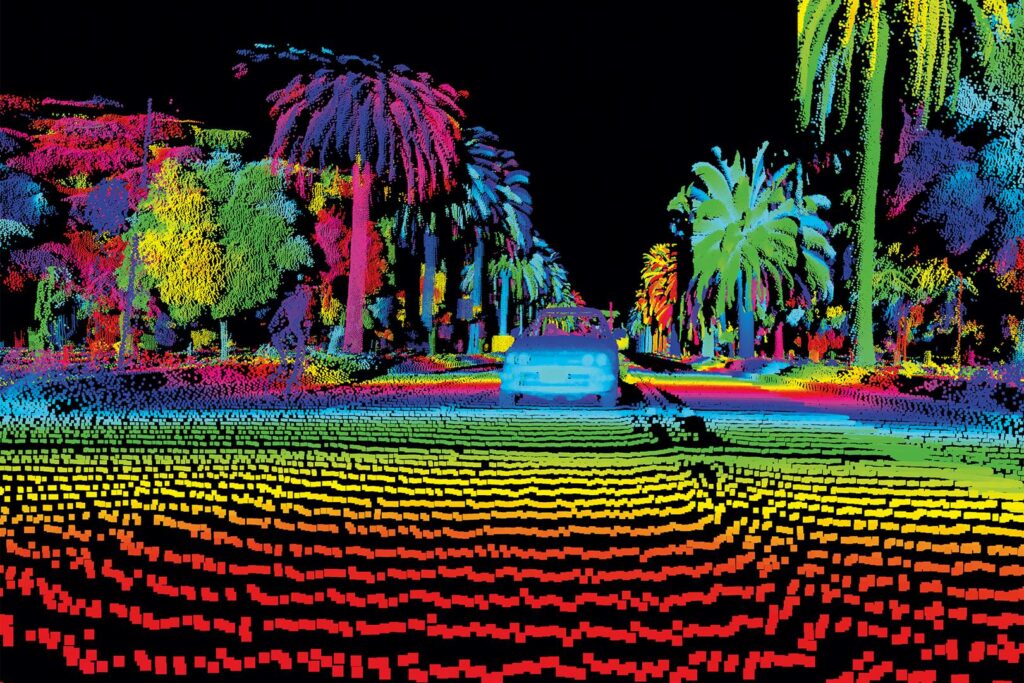
LiDAR is a sensor that measures distance with light and can be used to detect obstacles for vehicles and robots or to scan buildings.

Over 100 companies are working to develop LiDAR solutions that can bring the required high performance and are more economic in terms of costs and much smaller for better integration in vehicles, robots, and drones so that they can be easily portable.

Instructor

Dr. Farzad Parsaie

COURSE CONTENT

This course provides an overview of different LiDAR architectures in their use cases. Examples are Time of Flight (ToF) and FMCW techniques, where light can be scanned over the scene or illuminate the whole field of view with a flash.

The advantages and challenges of each case will be discussed in detail. The course will focus from System level to Transistor and Device level on all Electronic and Optoelectronic components and subsystems. Advanced discrete and integrated techniques and technologies like Analog/RF-Frontend topologies, Discriminator, ADC, ASIC process technology (CMOS, BiCMOS), (Co-) Packaging, different devices like Photodetectors and Laser Diodes as well as switches, switch drivers and power management techniques will be addressed extensively.

Solutions for miniaturization of novel LiDAR products through ASIC integration and (Co-) packaging will be shown with the goal how to reduce costs and improve performance.

WHO SHOULD ATTEND

This is a course about the development of LiDAR as a multi-disciplinary product, hence of interest for technical staff of different disciplines. They need to understand details and consider optimization on the higher product level and not only locally on a single discipline level. In general, it will be of interest to:

– Engineers, Physicists, Scientists, technical staff, and Students
– System Architects, Project Managers and Technical Managers
– Business Development Managers, Marketing Managers, who plan to be involved in specification and development of such a multi-disciplinary optoelectronic product and want to do business with it with fast Time to Market.
Day 1

Overview LiDAR and Architectures

  • Introduction LiDAR
  • Time of Flight (ToF) LiDAR, Flash and scanning LiDAR
  • AMCW, FMCW, FM Comb LiDAR
  • What is a solid-state LiDAR?
  • Light wavelength and Power, Eye Safety

Day 2

The Optical Receive Channel

Part1: Photodetectors

  • Introduction of discrete and integrated Photodetectors
  • Physical Principles and Technologies
  • Light power and wavelength sensitivity, materials
  • Noise sources, sensitivity, and speed

Day 3

The Optical Receive Channel

Part2: Electronic Interface and Signal Conditioning

  • Low noise and high-speed electronic Interfacing of Photodetectors
  • Discrimination topologies
  • Topologies for Analog to Digital Converters (ADC) and Time to Digital Converters (TDC)
  • Discrete (with off-the-shelf components) and integrated (ASIC) Realization
  • ASIC Integration Technologies and Challenges

Day 4

The Transmit Channel

  • Introduction of Light Sources
  • Laser Diode Control Electronics
  • Introduction and principles of Switch Components
  • Switch Driver Electronics and the parasitics to be minimized
  • EMC issues, Integration and Miniaturization

Day 5

Light Steering Methods, Power Management and Packaging

  • MEMS Mirrors for Light Steering (technology, challenges, sensing and control electronics, ASIC)
  • Optical Phased Arrays (OPA) and the role of Silicon Photonics
  • Power Management Topologies for LiDAR (discrete and integrated)
  • Electronic and Optoelectronic (Co-)Packaging and Hybrid Assembly

ALL COURSE DATES FOR THE CATEGORY: , ,

Circuit & System Design, RF & MW Design

030 PCB Filters and Multiplexers using Standard SMT Components

Location: Amersfoort, The Netherlands Date: May 18 – May 19, 2026 Duration: 2 days
Instructor: Mr. Daniel G. Swanson Jr., This course in PCB Filters and Multiplexers using Standard SMT Components, explore the capabilities of well-known topologies like combline, interdigital and edge coupled as well as lesser known printed lumped element topologies. Learn EM simulation and unique optimization methods that are keys to rapid, successful design. Read full course description including course schedule

Early Bird
1 560,00 1 735,00 
Early Bird Price Ends: March 20, 2026

Circuit & System Design, RF & MW Design

032 Planar Filters and Multiplexers

Location: Amersfoort, The Netherlands Date: May 20 – May 22, 2026 Duration: 3 days
Instructor: Mr. Daniel G. Swanson Jr. This 3-day course in Planar Filters and Multiplexers. Explore the capabilities of well-known topologies like combline, interdigital and edge coupled as well as lesser known printed lumped element topologies. Learn EM simulation and unique optimization methods that are keys to rapid, successful design. Read full course description including course schedule

Early Bird
2 280,00 2 535,00 
Early Bird Price Ends: March 20, 2026

Circuit & System Design, RF & MW Design

031 High Q Cavity Filters and Multiplexers

Location: Barcelona, Spain Date: April 15 – April 17, 2026 Duration: 3 days
Instructor: Mr. Daniel G. Swanson Jr. This 3-day course in High Q Cavity Filters and Multiplexers. Chebyshev and cross-coupled cavity combline filters are the preferred technology when high performance and relatively low cost filtering is required. Learn EM simulation and unique optimization methods that are keys to rapid, successful design. This course is focused on practical filter design methods for Cavity Combline Filters for Wireless Systems. The core material is a universal procedure for narrow band filter design that can be applied to virtually any filter technology or topology. The procedure is rooted in Dishal’s method with powerful extensions that include the port tuning concept, equal ripple optimization techniques, and efficient EM simulation. All the techniques presented can be implemented using commercially available CAD tools. Read full course description including course schedule

Early Bird
2 280,00 2 535,00 
Early Bird Price Ends: February 13, 2026

Circuit & System Design, RF & MW Design

030 PCB Filters and Multiplexers using Standard SMT Components

Location: Barcelona, Spain Date: April 13 – April 14, 2026 Duration: 2 days
Instructor: Mr. Daniel G. Swanson Jr., This course in PCB Filters and Multiplexers using Standard SMT Components, explore the capabilities of well-known topologies like combline, interdigital and edge coupled as well as lesser known printed lumped element topologies. Learn EM simulation and unique optimization methods that are keys to rapid, successful design. Read full course description including course schedule

Early Bird
1 560,00 1 735,00 
Early Bird Price Ends: February 13, 2026

Sensors and Digital Imaging

835 A 360-degree View of the Sensors for Industrial Applications – Focusing on the Inductive Sensors

Location: Gothenburg, Sweden Date: June 22 - June 26, 2026 Duration: 5 days
Instructor: Dr. Sorin Fericean This 5-day course on how to get familiar and experienced with the extremely large types and versions of sensors for industrial applications.

He is a new instructor of the CEI-Europe and is a professional expert on the subject of design and manufacturing of electronic sensors and ASIC designing, testing, and release for such products. After more than 25 years with one of the 10 global players on the field of industrial sensors – Balluff GmbH Company, Germany – he is currently as a freelancer in his consulting office FerSensC / Leonberg, Germany, carrying out sensor design projects and consulting.

Read full course description including course schedule

Early Bird
3 540,00 3 935,00 
Early Bird Price Ends: April 22, 2026

Sensors and Digital Imaging

014 Digital Camera Systems

Location: Brussels, Belgium Date: September 29 - October 2, 2026 Duration: 4 days
Instructor: Professor Albert J.P Theuwissen Digital cameras are an essential part of our daily life, e.g. in mobile phones, camcorders, digital photography, cars, and in imaging applications for medical, industrial and broadcasting. This 4-day course is developed to provide theoretical familiarity and hands-on experience with digital cameras and associated topics with focus on the overall system aspects. The complete path will be discussed from “photons in” to “digital numbers out”. The effect of light sources, optics, imagers, defects, and data processing will be covered. Read full course description including course schedule

Early Bird
2 940,00 3 265,00 
Early Bird Price Ends: July 29, 2026

Sensors and Digital Imaging

020 Advanced Course on Image Sensor Technology

Location: Barcelona, Spain Date: April 13 - April 15, 2026 Duration: 3 days
Instructor: Professor Albert J.P Theuwissen Highly sophisticated CMOS image sensors are key components of modern cameras. Technology as well as device architectures are optimized to obtain peak performance of the image sensor and the camera system. The most advanced CMOS image sensors show pixel sizes beyond 1 µm. The imagers demonstrate a light sensitivity comparable to that of the human eye. This course is intended for the specialists in the field. A very good background of digital imaging is needed to get the most out of this course. Read full course description including course schedule

Early Bird
2 280,00 2 535,00 
Early Bird Price Ends: February 13, 2026

Sensors and Digital Imaging

063 Advanced Optical Sensors: From Detectors to ASIC Integration with Edge AI and Functional Safety Considerations

Location: Gothenburg, Sweden Date: June 22 - June 25, 2026 Duration: 4 days
Instructor: Dr. Farzad Parsaie Optical sensors are evolving toward intelligence, downsizing, and multi-functionality, with critical roles in functional safety applications like autonomous driving, industrial automation, and medical diagnostics. Artificial Intelligence (AI) is enhancing optical sensor performance by improving data processing, signal-to-noise ratios, and handling dynamic scenarios, essential for high-fidelity measurements in these fields. This course covers these advancements, from photodetector fundamentals to ASIC integration and interfacing, with a focus on Edge AI and Functional Safety. Read full course description including course schedule

Early Bird
2 940,00 3 265,00 
Early Bird Price Ends: April 22, 2026

Sensors and Digital Imaging

063 Advanced Optical Sensors: From Detectors to ASIC Integration with Edge AI and Functional Safety Considerations

Location: Amersfoort, The Netherlands Date: May 18 - May 21, 2026 Duration: 4 days
Instructor: Dr. Farzad Parsaie Optical sensors are evolving toward intelligence, downsizing, and multi-functionality, with critical roles in functional safety applications like autonomous driving, industrial automation, and medical diagnostics. Artificial Intelligence (AI) is enhancing optical sensor performance by improving data processing, signal-to-noise ratios, and handling dynamic scenarios, essential for high-fidelity measurements in these fields. This course covers these advancements, from photodetector fundamentals to ASIC integration and interfacing, with a focus on Edge AI and Functional Safety. Read full course description including course schedule

Early Bird
2 940,00 3 265,00 
Early Bird Price Ends: March 18, 2026

Would you like an in-house course?

Contact Us!

Share your details below, and our team will be in touch as soon as possible.