
Course 064 LiDAR Sensors from System to Transistor/Device Level and Miniaturization through ASIC and (Co-)Packaging
Available course dates
This course has no planned course dates.
If you are interested in this course, contact us at cei@cei.se
TECHNOLOGY FOCUS
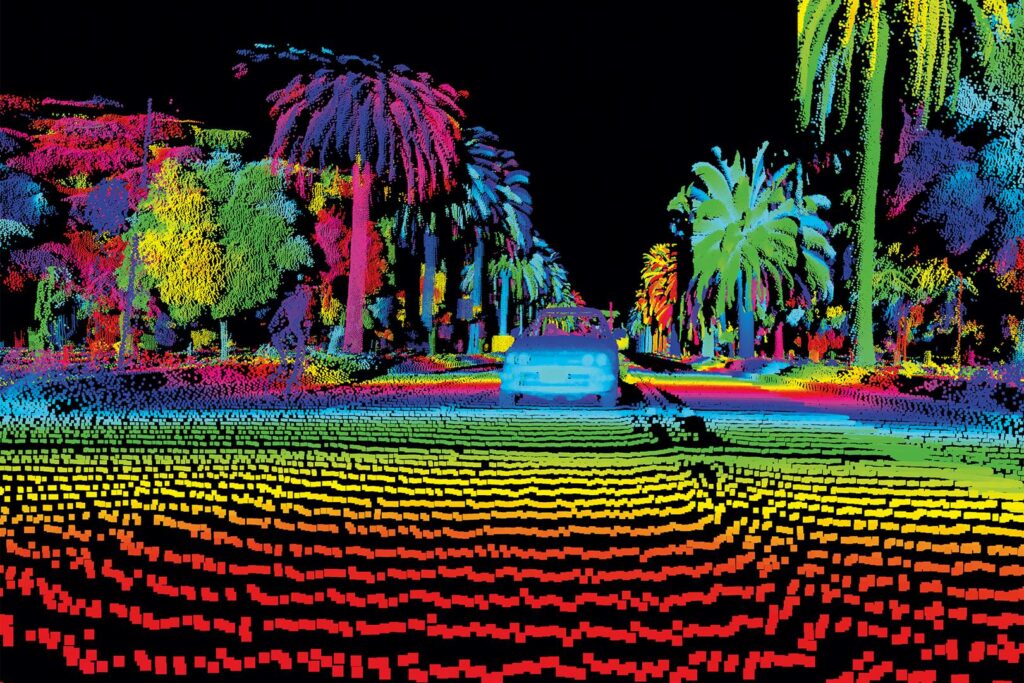
LiDAR is a sensor that measures distance with light and can be used to detect obstacles for vehicles and robots or to scan buildings.
Over 100 companies are working to develop LiDAR solutions that can bring the required high performance and are more economic in terms of costs and much smaller for better integration in vehicles, robots, and drones so that they can be easily portable.
COURSE CONTENT
This course provides an overview of different LiDAR architectures in their use cases. Examples are Time of Flight (ToF) and FMCW techniques, where light can be scanned over the scene or illuminate the whole field of view with a flash.
The advantages and challenges of each case will be discussed in detail. The course will focus from System level to Transistor and Device level on all Electronic and Optoelectronic components and subsystems. Advanced discrete and integrated techniques and technologies like Analog/RF-Frontend topologies, Discriminator, ADC, ASIC process technology (CMOS, BiCMOS), (Co-) Packaging, different devices like Photodetectors and Laser Diodes as well as switches, switch drivers and power management techniques will be addressed extensively.
Solutions for miniaturization of novel LiDAR products through ASIC integration and (Co-) packaging will be shown with the goal how to reduce costs and improve performance.
WHO SHOULD ATTEND
This is a course about the development of LiDAR as a multi-disciplinary product, hence of interest for technical staff of different disciplines. They need to understand details and consider optimization on the higher product level and not only locally on a single discipline level. In general, it will be of interest to:
– Engineers, Physicists, Scientists, technical staff, and Students
– System Architects, Project Managers and Technical Managers
– Business Development Managers, Marketing Managers, who plan to be involved in specification and development of such a multi-disciplinary optoelectronic product and want to do business with it with fast Time to Market.
Daily Schedule
Day 1
Overview LiDAR and Architectures
- Introduction LiDAR
- Time of Flight (ToF) LiDAR, Flash and scanning LiDAR
- AMCW, FMCW, FM Comb LiDAR
- What is a solid-state LiDAR?
- Light wavelength and Power, Eye Safety
Day 2
The Optical Receive Channel
Part1: Photodetectors
- Introduction of discrete and integrated Photodetectors
- Physical Principles and Technologies
- Light power and wavelength sensitivity, materials
- Noise sources, sensitivity, and speed
Day 3
The Optical Receive Channel
Part2: Electronic Interface and Signal Conditioning
- Low noise and high-speed electronic Interfacing of Photodetectors
- Discrimination topologies
- Topologies for Analog to Digital Converters (ADC) and Time to Digital Converters (TDC)
- Discrete (with off-the-shelf components) and integrated (ASIC) Realization
- ASIC Integration Technologies and Challenges
Day 4
The Transmit Channel
- Introduction of Light Sources
- Laser Diode Control Electronics
- Introduction and principles of Switch Components
- Switch Driver Electronics and the parasitics to be minimized
- EMC issues, Integration and Miniaturization
Day 5
Light Steering Methods, Power Management and Packaging
- MEMS Mirrors for Light Steering (technology, challenges, sensing and control electronics, ASIC)
- Optical Phased Arrays (OPA) and the role of Silicon Photonics
- Power Management Topologies for LiDAR (discrete and integrated)
- Electronic and Optoelectronic (Co-)Packaging and Hybrid Assembly
ALL COURSE DATES FOR THE CATEGORY: Automotive, Circuit & System Design, Sensors and Digital Imaging
E-Course Bundle 601-603 Advanced course in image sensors and digital cameras
Instructor: Professor Albert J.P Theuwissen
The course includes:- 284 minutes on-demand video
- 80 modules
- 12 months access
E-Course 601 Introduction to Correlated and Uncorrelated Noise in Imagers
Instructor: Professor Albert J.P Theuwissen
Introduction to Correlated and Uncorrelated Noise in Imagers In the introduction of the course, the difference between Correlated and Uncorrelated Noise will be explained. In a first instance, one can put all fixed-pattern noise sources or noise in the spatial domain under the header of Correlated Noise, and one can put all temporal noise sources or noise in the time domain under the header of Uncorrelated Noise. The course includes:- 42 minutes on-demand video
- 9 modules
- 3 months access
E-Course 603 Characterization of Noise with Light
Instructor: Professor Albert J.P Theuwissen
Characterization of Noise with Light In the third and last part of the course, the image sensor will be characterized with light input. First the fixed-pattern noise (= correlated noise) will be measured, and next the temporal noise (= uncorrelated noise) will be characterized. All measurements will be based on an existing camera and with uniform light input. For both noise types, correlated and uncorrelated, some extra statistical operations will allow to split the overall noise characterized into a contribution on row level, on column level and on pixel level. This gives very useful information on where to find the root cause of the noise sources. The course includes:- 126 minutes on-demand video
- 34 modules
- 3 months access
E-Course 602 Characterization of Noise in Dark
Instructor: Professor Albert J.P Theuwissen
Characterization of Noise in Dark It may sound strange that an image sensor, which is made to capture light, will be characterized first in dark conditions. But actually this should not really be surprising because noise will first become visible in the darkest parts of an image. For that reason the dark performance of an image sensor plays crucial role. It also sets the lower end of the dynamic range…… The course includes:- 116 minutes on-demand video
- 37 modules
- 3 months access